Close your eyes for a second and imagine this.
Imagine waking up without the weight. Without the anger simmering beneath the surface. Without the anxiety stealing your sleep. Without the shame telling you you’re not enough.
Imagine what your life would look like if you were free from the burdens you’ve been carrying.
How would you show up differently? What would you do that you can’t do now? How would you feel in your own skin?
Most of us can name what we don’t want. We know what we’re trying to escape. But we have no vision for what we’re moving toward.
We’re running from something instead of running to something.
And that’s a problem. Because if you don’t know where you’re going, you’ll never get there.
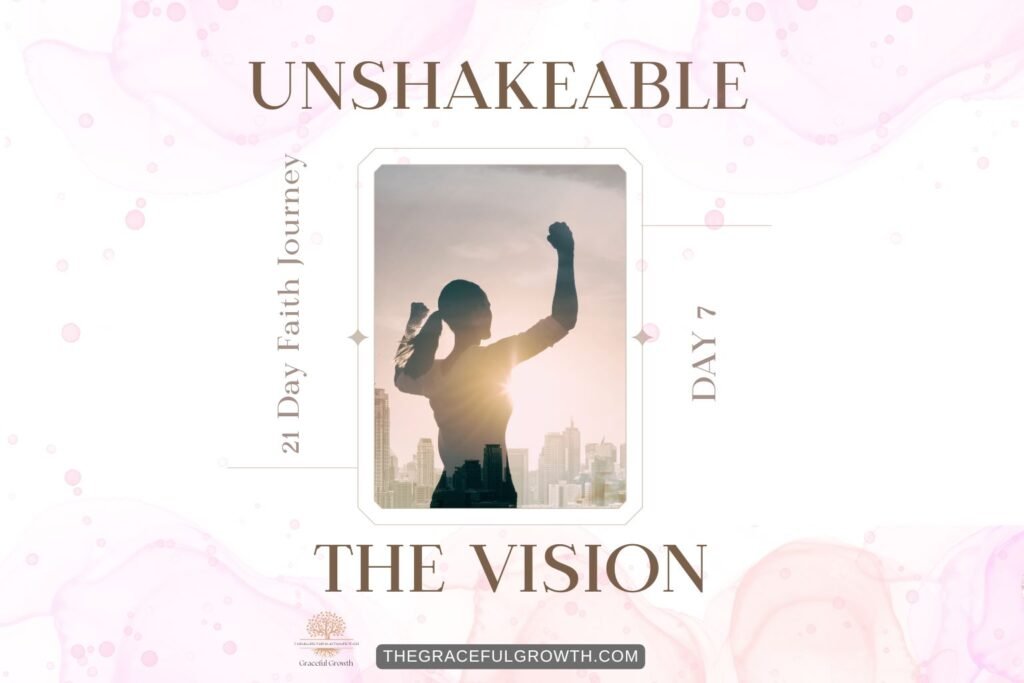
Today is Day 7 of the Unshakeable journey, and we’re painting a picture. Not of who you wish you were. But of who you’re becoming by God’s grace. What does freedom actually look like in your daily life?
So Let’s start dreaming together!
But before we dive in…
Welcome to Graceful Growth in Midlife. I’m Toresa.
If you’re new here, this podcast is where we navigate cultural chaos and personal struggles with biblical clarity and grace. We’re figuring this out together…creating unshakeable faith in an unstable world!
Before we jump in, if you haven’t joined the free Unshakeable: 21-Day Faith Journey yet, you can sign up at thegracefulgrowth.com/unshakeable. It’s a complete downloadable workbook with daily emails walking you through Discovery, Understanding, and Healing – designed to help you build unshakeable faith in an unstable world.
Now, here’s the thing – this is called a 21-day journey, but you don’t have to do it in 21 consecutive days. You can work through it at your own pace. Take time to absorb. Sit with the hard questions. Some days might need more than one day. And that’s completely okay. This isn’t a race. It’s about depth, not speed.
Also, if you find you need more space for journaling than what’s provided in the workbook, there are additional journal pages in the back. Use them. Fill them up. This is YOUR journey, and you get to make it work for you.
And these episodes? They’re your companion content, going even deeper into each day’s themes.
Alright. Let’s get into this.
So we’ve spent six days doing the hard work of discovery.
You named what brought you here. You identified the strongholds and lies keeping you stuck. You looked honestly at who you are right now. You made your burden list. You traced the ripple effect.
You’ve done the excavation work. You’ve looked beneath the surface. You’ve gotten honest about what needs to change.
And today – before we move into Week 2 – we’re looking forward.
Because transformation isn’t just about moving away from something. It’s about moving toward something.
And if you don’t have a vision for who you’re becoming, you’ll keep circling back to who you’ve always been.
Proverbs 29:18 says “Where there is no vision, the people perish.”
That word “perish” in the original Hebrew means to cast off restraint, to run wild, to live without direction.
In other words, without vision, you drift. You lose focus. You end up back where you started because you had no clear picture of where you were going.
So today, we’re creating that picture.
Not a fantasy. Not an idealized version of yourself that doesn’t exist.
But a real, concrete, specific vision of what freedom looks like for you in your actual, daily life.
What does the healed version of you do on a Tuesday afternoon? How does she respond when things don’t go her way? What does she believe about herself that you don’t believe right now?
We’re painting that picture today. Not so you can beat yourself up for not being there yet. But so you have something to move toward. A target. A vision.
Because faith without vision is just wishing. But vision without faith is just dreaming.
We need both. A clear picture of where we’re going and faith that God can get us there.
So let’s paint that picture.
PART 1: Imagine Freedom
The first question in your workbook asks: Imagine yourself on the other side of these struggles – healed, free, whole. What does your life look like? How do you feel?
And I want to push you on this because most of us answer this question in vague, general terms.
“I’d be happy.” “I’d have peace.” “I’d feel free.”
Okay, but what does that actually look like?
Let me give you some examples of what specific, concrete vision looks like.
Example 1: Freedom from Anger
Vague: “I wouldn’t be angry all the time.”
Specific: “I could have a hard conversation with my teenager without my blood pressure spiking. I could hear criticism without immediately getting defensive. I could feel the anger rising and actually pause, breathe, and choose how to respond instead of just reacting. I could drive in traffic without rage. I could disagree with someone without needing to win. I could be triggered by something and not let it ruin my entire day.”
Do you see the difference? The specific version gives you something to aim for. Something you can actually measure progress against.
Example 2: Freedom from Comparison
Vague: “I wouldn’t compare myself to other people.”
Specific: “I could scroll social media and genuinely celebrate someone else’s win without it triggering my own sense of inadequacy. I could show up to church and actually worship instead of spending the whole time cataloging everything everyone else is doing better than me. I could look in the mirror and see a daughter of God instead of a list of everything that’s wrong with me. I could receive a compliment without immediately deflecting it or thinking they don’t really mean it.”
See how much more helpful that is? You’re not just naming what you won’t do. You’re describing what you will do.
Example 3: Freedom from Fear
Vague: “I wouldn’t be anxious all the time.”
Specific: “I could make a decision without second-guessing myself for days. I could let my kids take age-appropriate risks without panicking. I could go to bed without my mind racing through every possible thing that could go wrong tomorrow. I could trust that God has me even when I can’t see the path forward. I could sit with uncertainty without needing to control everything.”
Example 4: Freedom from Shame
Vague: “I wouldn’t feel bad about myself.”
Specific: “I could be vulnerable with safe people without fearing they’ll confirm what I already believe about myself. I could make a mistake without it meaning I’m a failure. I could receive love without constantly trying to earn it. I could show up as my real self instead of performing a version I think people will accept.”
Example 5: Freedom from Food Struggles
Vague: “I’d have a healthy relationship with food.”
Specific: “I could have a hard day and not immediately turn to the pantry. I could eat a meal without guilt or shame. I could feel my feelings instead of eating them. I could nourish my body without making it a moral issue. I could enjoy a dessert without spiraling into ‘I’ve already ruined the day so I might as well eat everything.'”
Do you see what we’re doing?
We’re not just saying “I want to be free.” We’re describing what freedom actually looks like in your real, everyday life.
Not in some perfect fantasy world. But in your actual life with your actual struggles and your actual relationships.
What does freedom look like on a Tuesday? What does it look like when your kid spills milk all over the floor you just cleaned? What does it look like when your spouse says something that would normally trigger you? What does it look like when you’re stressed or tired or overwhelmed?
That’s the vision we’re creating.
Not perfection. But progress. Not arrival. But movement toward.
A version of you who’s been healed, who’s been set free, who’s learned to live differently because she believes differently.
PART 2: What Would You Be Able To Do?
The second question asks: What would you be able to do or become if these burdens were no longer weighing you down?
This question is about capacity.
Because right now, you’re using so much energy managing your burdens that there’s nothing left for anything else.
You’re surviving, not thriving. You’re going through the motions, not actually living.
But if you weren’t spending all that energy on managing, controlling, hiding, performing – what could you do instead?
Let me give you some examples.
If you weren’t consumed by anxiety:
You could actually be present with your kids instead of constantly distracted by worst-case scenarios.
You could take risks. Try new things. Say yes to opportunities that scare you instead of always playing it safe.
You could rest without guilt. Sleep without your mind racing. Be still without needing to fill every moment with productivity.
You could trust God with outcomes instead of trying to control everything yourself.
If you weren’t trapped in people-pleasing:
You could say no without guilt. Set boundaries without apologizing. Disappoint people without it destroying you.
You could show up as your real self instead of performing a version you think people will accept.
You could pursue what God is calling you to instead of what everyone else expects of you.
You could have opinions. Take up space. Stop shrinking yourself to make others comfortable.
If you weren’t carrying shame:
You could be vulnerable. Let people see the real you. Stop hiding behind the mask of having it all together.
You could receive love without constantly trying to earn it. Accept grace without feeling like you don’t deserve it.
You could make mistakes without it meaning you’re fundamentally flawed.
You could celebrate your wins without downplaying them. Own your strengths without feeling like you’re being prideful.
If you weren’t consumed by comparison:
You could run your own race instead of constantly looking sideways at what everyone else is doing.
You could celebrate other people’s wins without it making you feel like you’re losing.
You could use your unique gifts instead of trying to be someone you’re not.
You could stop measuring your worth by how you stack up against others.
If you weren’t trapped in control:
You could delegate. Trust other people. Let go of outcomes you can’t control anyway.
You could be spontaneous. Flexible. Adapt when things don’t go according to plan without it derailing you.
You could collaborate instead of micromanaging. Partner instead of dominating.
You could rest in God’s sovereignty instead of bearing the weight of holding everything together yourself.
See what I’m getting at?
Your burdens aren’t just making you miserable. They’re limiting what you can do, who you can become, how you can show up.
And on the other side of healing? There’s capacity.
Capacity to be fully present. Capacity to take risks. Capacity to be vulnerable. Capacity to rest. Capacity to pursue what God is calling you to.
That’s not just about feeling better. That’s about becoming who you were created to be.
So what would you be able to do if you weren’t carrying what you’re carrying?
What dreams have been buried under the weight? What callings have you been too exhausted to pursue? What relationships could deepen if you had capacity for them?
Write it down. Be specific.
Not “I’d be a better person.” But “I could pursue that business idea I’ve been too scared to try. I could invest in that friendship instead of keeping everyone at arm’s length. I could be the mom who’s present instead of just physically there.”
Paint the picture of what becomes possible on the other side.
PART 3: Do You Believe God Can?
The third question is the hardest: Do you believe God can transform you into that person? What makes you doubt? What gives you hope?
Because here’s the thing – you can have all the vision in the world, but if you don’t believe transformation is actually possible for you, you won’t fight for it.
You’ll give up at the first obstacle. You’ll convince yourself it works for other people but not for you. You’ll stay stuck because somewhere deep down, you don’t believe you can actually change.
So let’s talk about doubt first.
What makes you doubt that God can transform you?
Maybe it’s: “I’ve tried before and failed. I’ve made commitments and broken them. I’ve had breakthroughs that didn’t last. So why would this time be different?”
Or maybe: “Other people can change, but I’m too broken. My struggles are too deep. My patterns are too entrenched. It’s too late for me.”
Or maybe: “I don’t deserve transformation. I’ve made too many mistakes. I’ve hurt too many people. God might help others, but not me.”
Or maybe: “I’m scared of what transformation will cost. What if God asks me to do something I don’t want to do? What if freedom requires more of me than staying stuck does?”
These doubts are real. They’re not silly or unfounded.
They’re based on real experiences. Real pain. Real fear.
But here’s what I need you to hear: your doubt doesn’t disqualify you from God’s transformation.
In fact, doubt is often the soil where the deepest faith grows.
Because faith isn’t the absence of doubt. Faith is choosing to trust God even when you have doubts.
The father in Mark 9 said to Jesus “I do believe; help me overcome my unbelief!”
He had faith AND doubt at the same time. And Jesus didn’t reject him. He helped him.
So if you’re doubting whether God can really transform you – that’s okay. Bring the doubt. Acknowledge it. But don’t let it have the final word.
Now let’s talk about hope.
What gives you hope that transformation is possible?
Maybe it’s Scripture. Verses that promise God is working in you, transforming you, completing what He started.
2 Corinthians 5:17: “Therefore, if anyone is in Christ, the new creation has come: The old has gone, the new is here!”
You ARE a new creation. Not someday. Not once you get your act together. Right now. The transformation has already begun.
Philippians 1:6: “Being confident of this, that he who began a good work in you will carry it on to completion until the day of Christ Jesus.”
He started the work. And He will finish it. Your job isn’t to complete yourself. Your job is to cooperate with what He’s already doing.
2 Corinthians 3:18: “And we all, who with unveiled faces contemplate the Lord’s glory, are being transformed into his image with ever-increasing glory, which comes from the Lord, who is the Spirit.”
Being transformed. Present tense. Ongoing. Not a one-time event but a continual process.
Or maybe your hope comes from seeing God do it for others. Watching someone you know experience real transformation. Seeing that change is possible, even if you haven’t experienced it yourself yet.
Or maybe your hope comes from small wins you’ve already had. Places where God has already done some healing. Evidence that He’s faithful, even if the transformation isn’t complete yet.
Whatever gives you hope – hold onto that.
Write it down. Come back to it when the doubt creeps in. Remind yourself that God is able, even when you’re not sure you are.
Because here’s the truth: Transformation isn’t about your ability. It’s about His.
You don’t have to be strong enough. Smart enough. Disciplined enough. Faithful enough.
You just have to be willing. Willing to let Him work. Willing to cooperate. Willing to keep showing up even when it’s hard.
That’s all He needs from you.
PRACTICAL APPLICATION
So here’s your action step for today.
In your workbook, answer those three questions in as much detail as you can:
- Imagine yourself on the other side of these struggles. What does your life look like? How do you feel? Be specific. Paint the picture in concrete, daily terms.
- What would you be able to do or become if these burdens were no longer weighing you down? What capacity would you have? What becomes possible?
- Do you believe God can transform you into that person? What makes you doubt? What gives you hope?
And then write a vision statement. A declaration of who you’re becoming by God’s grace.
Something like:
“By God’s grace, I am becoming a woman who is present instead of anxious. I will walk in freedom from the fear that’s controlled me for years.”
Or: “By God’s grace, I am becoming a woman who receives love without earning it. I will walk in freedom from the shame that’s kept me hiding.”
Or: “By God’s grace, I am becoming a woman who responds instead of reacts. I will walk in freedom from the anger that’s been destroying my relationships.”
Make it personal. Make it specific. Make it a declaration of faith.
Not “I hope” or “I wish” or “maybe someday.”
But “I am becoming” and “I will walk.”
Present tense. Forward motion. Confident hope that God is already at work.
This is your vision. Your target. Your reminder of where you’re going when the journey gets hard.
Congratulations – you just completed Week 1 of the Unshakeable journey. You did the hard work of Discovery. You looked beneath the surface. You got honest about what needs to change.
And next week, we move into Understanding. We’re going deeper. We’re asking why. We’re connecting the dots between your past and your present struggles.
The complete Unshakeable: 21-Day Faith Journey workbook is waiting for you at thegracefulgrowth.com/unshakeable. It’s free – workbook, daily emails, all of it.
If this resonated with you, subscribe so you don’t miss what’s coming. And I’d love to hear from you – leave a comment below!
Thanks for being here. I’ll see you next time.